What is the difference between module and circular pitch?
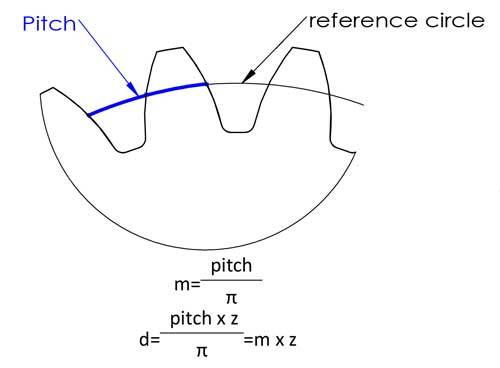
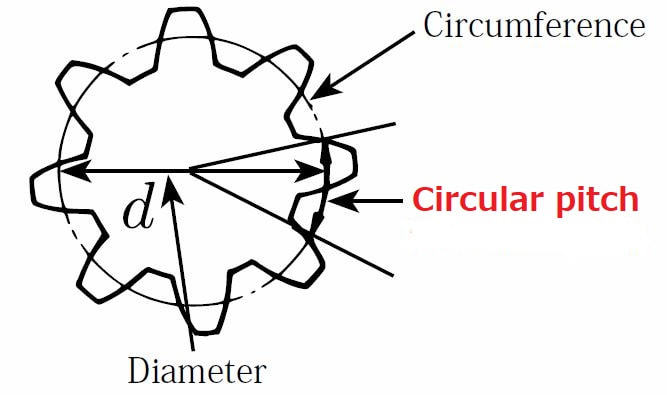
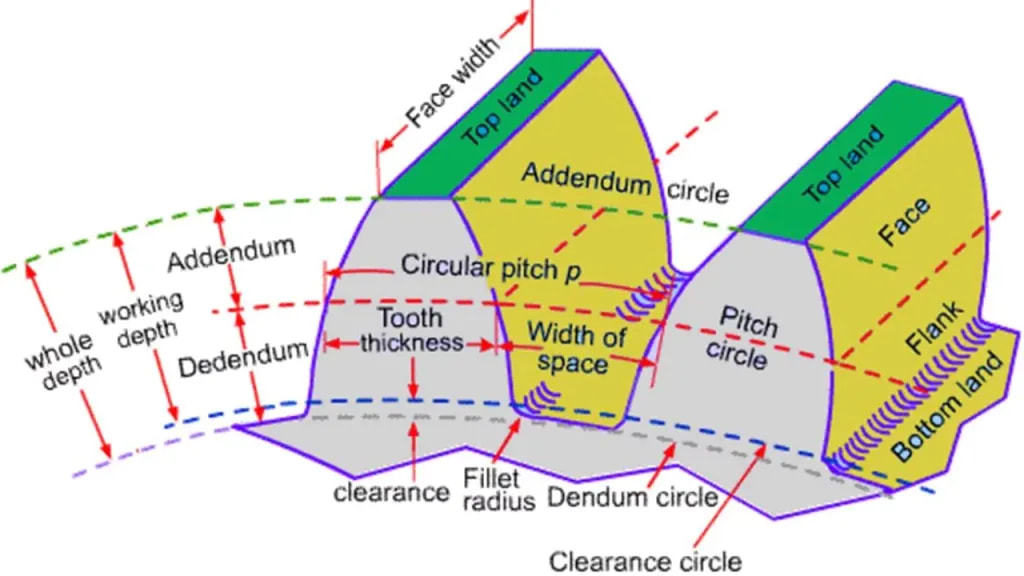
Module and circular pitch describe the same basic tooth size in different ways. Module is reference diameter divided by tooth count; circular pitch is the arc distance between corresponding points on adjacent teeth along the reference circle. For spur gears, p = πm. Both use length units, so a circular pitch of 5 mm is not module 5.
Module and circular pitch use different formulas
For a spur gear with reference diameter d and z teeth, use consistent millimeter units:
| Quantity | Formula |
|---|---|
| Module, m | d ÷ z |
| Circular pitch, p | πd ÷ z = πm |
| Module from circular pitch | p ÷ π |
Measure pitch along the reference circle, not as a straight gap between tooth tips. The reference circle is a geometric datum rather than a visible machined edge.
Worked comparison: module 2 and CP 5
Module 2: p = π × 2 ≈ 6.2832 mm.
CP 5: m = 5 ÷ π ≈ 1.5915 mm.
A 20-tooth CP 5 pinion advances a matched straight rack by 20 × 5 = 100 mm per full revolution in ideal geometry. CP racks can therefore make nominal travel per turn convenient to specify.
The calculation does not include backlash, positioning errors or elastic deflection.
Keep the reference plane consistent
For helical gears, distinguish normal and transverse values: pn = πmn and pt = πmt. Do not mix the two planes. Matching tooth size also requires compatible pressure angle, tooth form and other mating geometry.
When sending PairGears a drawing, identify the pitch system and units. See the spur gear pitch and measurement guide.
Related questions